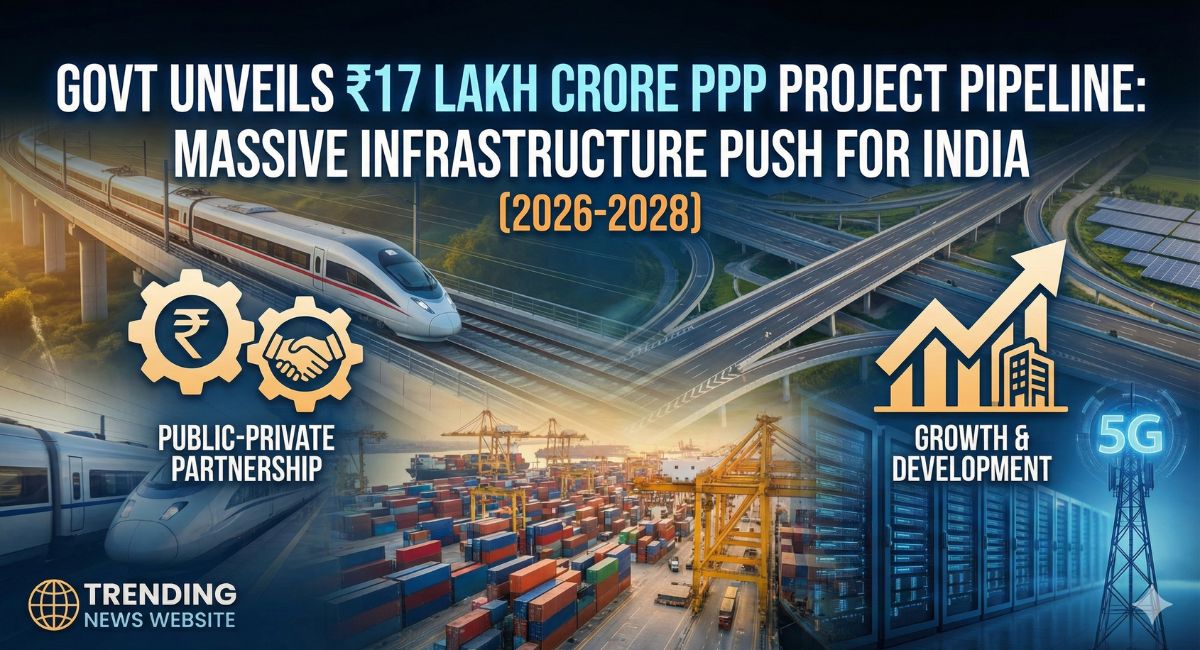
New Delhi: Ia historic move to transform India’s infrastructure landscape, the Central Government has officially launched a massive three-year Public-Private Partnership (PPP) project pipeline. The Department of Economic Affairs (DEA), under the Ministry of Finance, released the details this week, outlining a roadmap of 852 projects with a total investment value of over ₹17 Lakh Crore (approx. $206 Billion).
This announcement comes as a follow-up to the promises made in the Union Budget 2025-26, aiming to boost economic growth by inviting private companies to build roads, ports, and power plants. If you are wondering what this means for the country’s development and your city, here is a detailed breakdown of the entire plan.
What is the New PPP Pipeline?
The PPP Pipeline is essentially a “shopping list” or a structured roadmap of infrastructure projects that the government wants to build but cannot fund entirely on its own. Instead of using only taxpayer money, the government is inviting private companies (like L&T, Tata Projects, Adani, GMR, etc.) to invest, build, and operate these projects for a fixed period.
Key Highlights of the 2026 Pipeline:
- Total Investment: Over ₹17,00,000 Crore.
- Total Projects: 852 identified projects.
- Time Period: The projects are to be rolled out over the next three years (FY 2026, 2027, and 2028).
- Objective: To provide “early visibility” to investors. By announcing this list now, banks and developers can prepare their funding strategies in advance, preventing delays.
Sector-Wise Breakdown: Where is the Money Going?
The government has clearly prioritized connectivity and energy security. The breakdown of the projects shows a heavy focus on highways and power generation.
1. Roads & Highways (The Biggest Winner) The Ministry of Road Transport and Highways (MoRTH) continues to lead India’s infrastructure story.
- Share: It accounts for the largest chunk of the pipeline.
- Projects: 108 projects have been identified.
- Value: A staggering ₹8.77 Lakh Crore is allocated for roads alone.
- Impact: This means more expressways, bypasses, and six-lane highways will be built under the Build-Operate-Transfer (BOT) model, where private players collect tolls to recover their investment.
2. Power Sector
- Projects: 46 projects.
- Value: Approximately ₹3.4 Lakh Crore.
- Focus: Likely to include transmission lines and renewable energy projects to meet India’s growing electricity demand.
3. Ports & Shipping The Ministry of Ports, Shipping and Waterways is looking to modernize India’s coastline.
- Projects: 22 projects worth ₹37,644 Crore.
- Goal: To improve logistics efficiency and reduce shipping costs for Indian exporters.
4. Railways
- Projects: 13 major projects worth ₹30,904 Crore.
- Focus: Station redevelopment (turning stations into city centers) and dedicated freight corridors.
5. Water Resources
- Projects: 29 projects worth ₹12,253 Crore.
- Focus: River development, sewage treatment plants (STPs), and clean Ganga missions.
State-Wise Analysis: Andhra Pradesh Tops the List
One of the most interesting aspects of this report is the state-wise distribution. The data reveals which states are most aggressive in attracting private investment.
Andhra Pradesh: The Leader Andhra Pradesh has emerged as the surprise leader, topping the list with the highest number of proposed projects.
- Projects: 270 projects.
- Value: ₹1.16 Lakh Crore.
- Why: The state government is aggressively pushing for industrial corridors and port-led development to boost its economy.
Other Top States:
- Tamil Nadu: Secures the second spot with 70 projects worth ₹87,640 Crore. The state is focusing on manufacturing and urban infrastructure.
- Madhya Pradesh: A strong third with 21 projects worth over ₹65,000 Crore, focusing on road connectivity and logistics.
- Uttar Pradesh: Has lined up 89 projects worth ₹11,519 Crore.
- Jammu & Kashmir: Is also a key focus area with 57 projects worth ₹21,374 Crore, aiming to improve tourism and connectivity in the valley.
Why is the Government Pushing for PPP Now?
You might ask, why doesn’t the government just build these things itself? The answer lies in economics.
- Limited Funds: The government has spent record amounts of money (Capex) in the last 5 years to build infrastructure. Now, it needs to balance its books and reduce the fiscal deficit. It cannot keep spending at the same rate.
- Efficiency: Private companies are often faster at construction because their profit depends on finishing early.
- Technology: Private players bring better technology and management skills (e.g., automated tolling, smart grids) that government departments might lack.
- Asset Monetization: The government wants to “recycle” capital. By letting private players run completed assets (like highways or airports), the government gets upfront cash which it can use to build new projects in rural areas.
What Does This Mean for the Common Man?
This news might seem like high-level economics, but it impacts your daily life directly.
- Better Roads, but Higher Tolls: The push for BOT (Build-Operate-Transfer) roads means we will get world-class expressways, but we must be prepared to pay tolls. Private companies need to recover their ₹8.77 Lakh Crore investment.
- Job Creation: Infrastructure is the biggest creator of blue-collar jobs. ₹17 Lakh Crore of construction means millions of jobs for engineers, laborers, cement suppliers, and steel manufacturers over the next 3 years.
- Faster Travel: With new airports and railway station upgrades, travel time between cities will drop.
- Real Estate Boom: Areas near these new projects (especially in Andhra Pradesh and MP) will likely see a rise in land prices.
Challenges Ahead: Will It Succeed?
While the plan looks great on paper, India has had a mixed history with PPP projects.
- Stalled Projects: In the past, many private developers went bankrupt because land acquisition was delayed or traffic numbers were lower than expected.
- Financing Issues: Banks are sometimes scared to lend to long-term infrastructure projects due to bad loans (NPAs).
- Legal Disputes: Disputes between the government and private companies often drag on in courts for years.
To solve this, the government has promised a more “investor-friendly” contract this time, with clearer rules on risk-sharing.
Conclusion
The ₹17 Lakh Crore PPP Pipeline is a bold statement of intent. It shows that India is not slowing down its infrastructure growth despite global economic uncertainties. By partnering with the private sector, the government hopes to build a $5 Trillion economy faster. All eyes are now on the private players—will they bite the bait and invest?
Frequently Asked Questions (FAQs)
Q1: What is the full form of PPP?
PPP stands for Public-Private Partnership. It is a cooperative arrangement between the government (public) and private companies to finance, build, and operate projects like roads, parks, and hospitals.
Q2: Which state has the most projects in the 2026 pipeline?
Andhra Pradesh has the highest number of projects (270) valued at ₹1.16 Lakh Crore, followed by Tamil Nadu.
Q3: How many total projects are in this new list?
The pipeline contains 852 projects across various sectors like transport, energy, and water.
Q4: Will this increase toll taxes on highways?
Likely, yes. Since private companies are investing lakhs of crores to build these highways, they will recover the cost through toll collection over 15-20 years.
Q5: Who released this report?
The report was released by the Department of Economic Affairs (DEA), which is part of the Ministry of Finance, Government of India.
Q6: Is this related to the “National Infrastructure Pipeline” (NIP)?
Yes, this PPP pipeline is a part of the broader National Infrastructure Pipeline (NIP) but focuses specifically on projects where private investment is required.