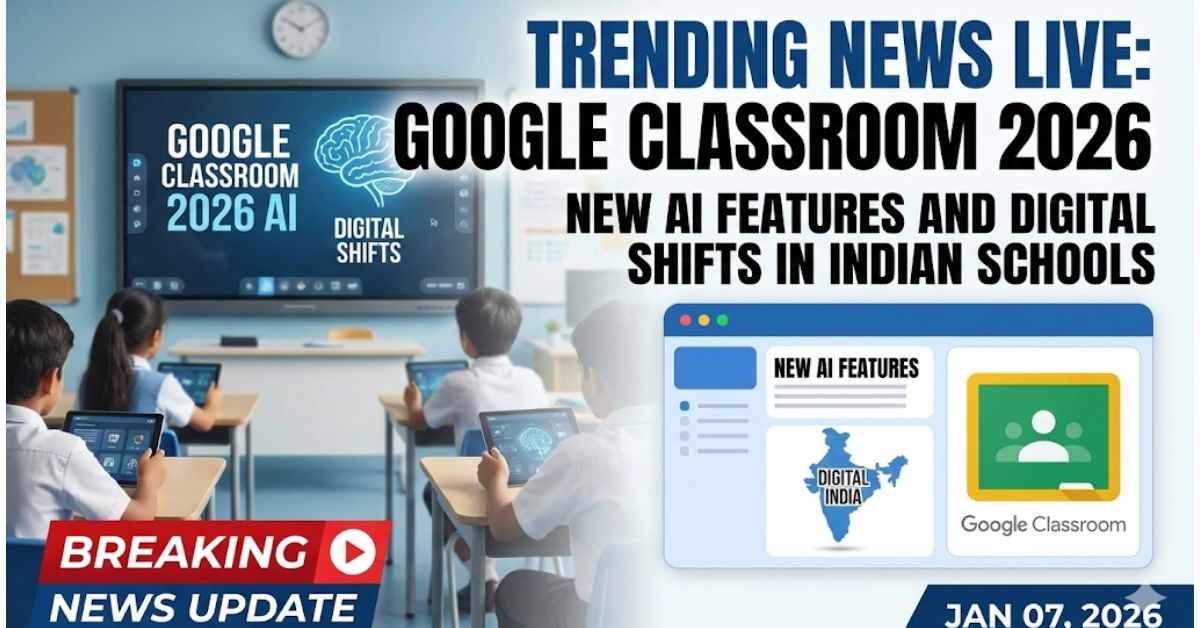
Education in India has moved far beyond the traditional chalkboard. As we enter 2026, Google Classroom has solidified its position as the backbone of the “Classroom Without Walls” movement across the country. From elite private institutions in Delhi to government schools adopting the National Education Policy (NEP) 2020 reforms, the platform is no longer just a “pandemic tool” but a permanent digital headquarters for learning.
Today, the focus has shifted from basic file sharing to AI-driven personalization. With the integration of advanced tools like Gemini, Google Classroom is helping Indian educators tackle one of their biggest challenges: managing large, diverse classrooms where students learn at very different speeds.
The AI Revolution: Gemini and Practice Sets
The most significant update for the 2026 academic cycle is the widespread rollout of AI-supported practice sets. This feature allows teachers to create interactive assignments that actually “talk back” to students. When a student struggles with a math problem or a science concept, the AI provides real-time hints and recommendations, acting like a virtual teaching assistant.
Another game-changer is the interactive YouTube video assignments. Teachers in India are increasingly using video content to explain complex topics. Now, they can embed specific questions directly into these videos. The video pauses, asks a question, and provides instant feedback, ensuring that “watching” becomes “active learning.”
Aligning with NEP 2020: Skills Over Rote Learning
Five years into the implementation of the National Education Policy (NEP) 2020, Google Classroom is playing a vital role in shifting the focus from rote memorization to competency-based teaching. The platform’s new Classroom Analytics dashboard allows school leaders to move beyond simple marks.
Educators can now track “learning standards” across an entire semester. By tagging assignments with specific skills—like “critical thinking” or “computational logic”—teachers get a data-backed view of where a student truly stands. This aligns perfectly with the NEP’s goal of holistic progress reports, making the annual “Value Audit” for schools much easier to conduct.
Bridging the Digital Divide with Mobile-First Learning
In India, the “Classroom” is often a smartphone. Recognizing that many students do not have access to dedicated laptops, Google has optimized the Classroom mobile app for low-bandwidth areas. Features like offline mode and “Zero Distance” banking of study materials allow students in semi-urban and rural areas to download lessons when they have a signal and study later.
The “Bring Your Own Device” (BYOD) model is also gaining traction in Indian colleges. By using Google Classroom as a centralized hub, students can access their digital portfolios, verify micro-credentials, and collaborate on group projects asynchronously, which is essential for the 150 million online learners currently estimated in the Indian ecosystem.
Security and Privacy in the Digital Age
As classrooms become more “Googlified,” concerns about data privacy and cybersecurity have grown. In 2026, Google has introduced enhanced cybersecurity protocols for Indian institutions. This includes AI-powered protections that block 99.9% of phishing and malware, alongside tighter “Admin” controls that allow schools to set strict data-sharing policies.
Moreover, the Originality Reports feature has been upgraded to detect AI-generated plagiarism. This helps maintain academic integrity as students experiment with generative AI tools, ensuring that they use technology as a co-pilot rather than a shortcut.
Frequently Asked Questions (FAQs)
1. Is Google Classroom free for schools in India?
Yes, the basic version—Google Workspace for Education Fundamentals—is free for qualifying institutional users. However, premium features like advanced AI tools and enhanced security require paid subscriptions like “Education Plus.”
2. Can I use Google Classroom without an internet connection?
The mobile app allows students to view assignments and open files offline if they have been previously downloaded. However, an internet connection is required to submit work and receive real-time updates.
3. How do I join a class on Google Classroom?
Students typically join using a unique “Class Code” provided by their teacher or through an email invitation sent directly to their registered school ID.
4. Does Google Classroom replace physical schools?
No. In the 2026 Indian context, it serves as a “Hybrid Learning” tool. It supports physical classrooms by organizing assignments, providing extra resources, and allowing for communication outside of school hours.
5. Is student data safe on Google Classroom?
Google for Education adheres to strict privacy standards. In India, they comply with the latest data protection guidelines, ensuring that student data is not used for advertising purposes and is protected by multi-layered encryption.